
Last Updated: July 23rd, 2026 | Reading Time: 20 minutes | Author: Samantha Stupak | Reviewed by Dr. Wendy Ormsby, Doctor of Chiropractic
I want to start by saying something that might surprise you: I understand why people are skeptical about bioenergetic testing.
I mean that sincerely. Before I founded CBH Energetics, before I analyzed over 50,000 bioenergetic scans, before I built a network of more than 1,000 practitioners worldwide, I was someone who got sick and couldn’t get answers.
I went through the conventional system. I did the bloodwork. I saw the specialists. And I kept being told I was fine when I clearly was not.
My journey into bioenergetics came out of desperation, not certainty. Which means I know exactly how a skeptical client feels sitting across from you, wondering if this is just another thing that sounds promising but won’t deliver.
That context shapes everything about how I train practitioners to have this conversation. From a place of genuine empathy and honest transparency, and not defensive justification.
This guide is everything I’ve learned from my own experience, from over fourteen years of practice, and from the real questions clients ask every single day about how to explain bioenergetic testing in a way that earns trust rather than demands it.
Why Clients Are Skeptical and Why That’s Actually Healthy
A client who comes in skeptical is a gift.
Skepticism means they are paying attention. It means they have been burned before by a wellness trend that didn’t deliver, by a test result that raised more questions than it answered, by a practitioner who promised more than they could honestly offer. A skeptical client has standards. And a client with standards who becomes a convert to bioenergetic testing becomes your most powerful advocate.
The mistake practitioners make is treating skepticism as an obstacle to overcome rather than a signal to listen to.
When a client asks, “Is bioenergetics testing real?” they are not always asking about the science. Most of the time, they are asking something more personal: “Is this safe to trust? Will you be honest with me? Am I going to walk out of here feeling like I wasted my money again?”
Those are fair questions. And the only honest answer to them is not a lecture about quantum physics or biofield research. It is a conversation that takes the client’s doubt seriously, explains things clearly, and lets them make their own informed decision.
That is the only kind of trust that lasts.
What Bioenergetic Testing Is and What It Is Not
Before you can explain bioenergetic testing to anyone else, you have to be crystal clear about this yourself. I train every CBH practitioner to know this distinction cold because it is the foundation of every confident conversation you will ever have.
What bioenergetic testing is:
A non-invasive wellness assessment that analyzes energetic stress patterns in the body. At CBH Energetics, we analyze hair and saliva samples using our custom-built bioenergetic testing system. The scan measures the hertz values emitted by the samples. It compares them against a massive library of known frequency signatures for hormones, nutrients, sensitivities, toxins, 14 body systems, and more. The result is a personalized bioenergetic picture of what the body appears to be working against.
What bioenergetic testing is not:
Bioenergetic testing is a wellness tool, not a medical diagnostic. It does not diagnose, treat, cure, or prescribe — and we are always clear about that with every client. Instead of disease language, we always use energetic language: we analyze patterns, we identify what is resonating, and we support the body toward balance.
That framing is not a limitation of the tool. It is an honest and powerful description.
How Does Bioenergetic Testing Work?
This explanation starts with something most people already accept without thinking: everything is energy.
Your body is made up of billions of cells. Those cells are made up of atoms. At the center of every atom is a nucleus containing positively charged protons and electrically neutral neutrons, and the vibration of those atoms produces a measurable energetic signature. Every cell has its own frequency. And we can either measure those signatures individually or take a collective reading, the way we might test the energetic state of the thyroid as a system, not just as a collection of individual cells.¹
Now here is the important part: everything else has a frequency too.
Borrelia, the bacterium associated with Lyme disease, has its own energetic signature. A banana has its own energetic signature. A heavy metal like mercury has its own energetic signature.
Every nutrient, every hormone, every toxin, every pathogen carries a measurable hertz value. We cannot see resonance with the naked eye. But we can measure it.
And energy is not fixed. Think about water. The matter H2O stays the same. But the energy changes completely depending on its state. A solid ice cube, liquid water, and steam are all the same matter expressing entirely different energetic states. The human body works the same way. The same physical matter can express very different energetic patterns depending on stress levels, toxic load, nutritional status, emotional state, and environment. Bioenergetic testing is reading those patterns.
How the CBH Bioenergetics Scan Actually Works
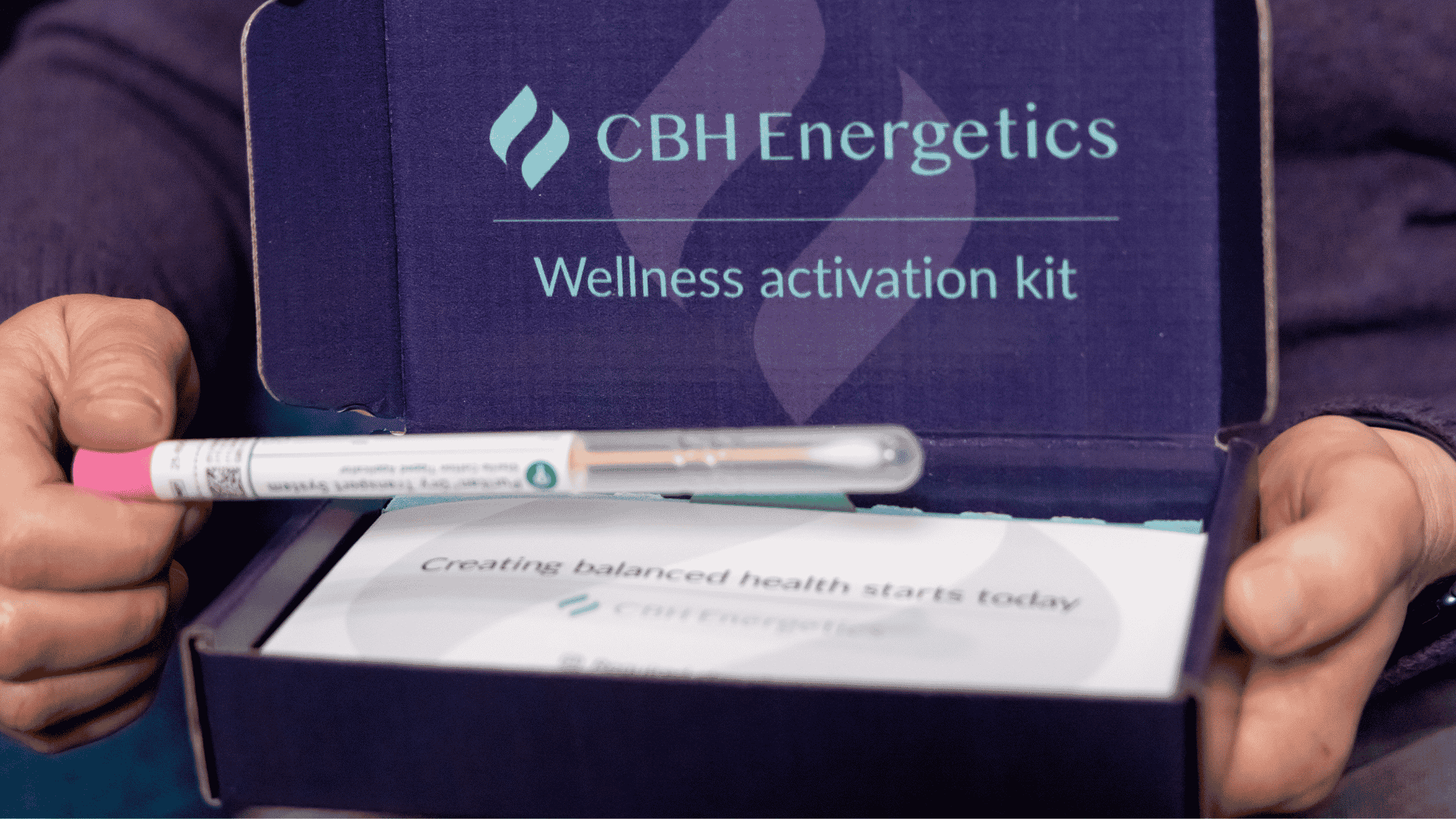
Here is a behind-the-scenes look at how a CBH scan actually works.
Our trained technicians use CBH’s bioenergetic testing hardware, connected to proprietary software, to analyze the hertz values from your hair and saliva samples. Hertz is simply a unit of measurement for frequency, and every substance in the body carries its own measurable frequency signature.
The technician moves through each body system in the software. For the liver, for example, a balanced reading typically falls in the range of approximately 49 to 59 hertz for most people, a reference point calibrated across a broad population that reflects what energetic balance looks like for that system.
If the reading on the liver registers at 65 hertz, that indicates mild energetic stress. If it moves into 75 hertz and above, that reflects more chronically elevated energetic stress; the body is working harder, showing more of what we associate with inflammatory patterns. The higher above the reference range, the more significant the energetic stress signal.
If the reading drops below the reference range, below approximately 47 hertz, that indicates weakness rather than inflammatory patterns. This is the body on the other side of the spectrum: not overworking, but underperforming energetically. A body that has been in a prolonged inflammatory state and is now showing signs of depletion. The lower the reading, the more work that system may need to come back into balance.
How Different Categories Are Read
| Category | How It Shows Up in the Scan |
| Nutrients | Appear as a missing signature. When we are looking for a nutritional imbalance, we look for a gap in the energetic pattern and then find what fills that void through a signature filtration process. |
| Toxins | We are not looking for a missing signature; we are looking for a match that should not be there. A resonating toxin means the body’s energetic pattern is aligning with the signature of something like mercury, a bacterium, or a fungus. It should not be present at that level, and its resonance is the signal. |
| Hormones | Interpreted similarly to nutrients: we assess whether the hormonal signature is present and balanced, or whether it is high or low relative to its reference range.
|
| Food and Environmental Sensitivities | Stress patterns are found when signatures to specific items fall outside the normal reference range of 49-59 Hz.
|
The Analogy Toolkit: Frameworks That Work in Real Conversations
Analogies are the most powerful tool in a bioenergetic practitioner’s communication toolkit because they make the science accessible to someone who is encountering it for the first time.
Here are the ones that consistently land well.
The EKG Bridge
“You’ve probably had an EKG at some point, right? When you get one, a machine reads the electrical signals your heart produces and gives your doctor a picture of how your heart is functioning. Nobody questions whether that’s real; we’ve used it for decades. Bioenergetic testing operates on that same foundational principle. The body produces measurable electrical and energetic signals. We’re just applying it more broadly across 14 body systems instead of just the heart.”
The Smoke Detector
“Blood work is excellent at telling you when something has already gone wrong enough to show up in your chemistry. It’s like a fire alarm going off after the fire has started. A bioenergetics scan is more like a smoke detector. It’s designed to pick up signals that something is changing before it’s crossed into a crisis. It doesn’t tell you your house is on fire. It tells you there’s smoke worth paying attention to.”
The Water Analogy
“Think about water. The matter stays exactly the same: H2O. But the energy looks completely different depending on whether it’s solid ice, liquid water, or steam. The human body works the same way. Your physical matter doesn’t change dramatically from day to day. Still, your energetic state can shift significantly based on stress, exposure, nutrition, and what your body is working against at any given moment. That’s what we’re reading.”
The Tuning Fork
“You know how if you strike a tuning fork, another tuning fork nearby tuned to the same frequency will start vibrating without ever being touched? That’s resonance. The frequencies align. Your body’s cells carry energetic frequency patterns, and those patterns are present in your biological tissue, including your hair and saliva. When we analyze those samples against a reference library of known frequency signatures, we’re asking: which of these frequencies is your body currently resonating with? Where is there alignment, and where is there disruption?”
The Road Map
“Think of it this way. You’ve been trying to get somewhere, and you keep hitting dead ends. Blood work gave you one piece of the map. A specialist gave you another. But none of the pieces are fitting together. A bioenergetics scan doesn’t give you more pieces of the same map; it gives you a different kind of map entirely. It shows you the terrain, not just the roads. It doesn’t tell you where you’re going. But it often shows you things that were always there that nobody had looked at before.”

The Three Types of Skeptical Clients
After 14 years and more than 50,000 scans, I’ve noticed that questions about bioenergetic testing tend to come from a few different places. Understanding where a client is coming from helps you meet them there rather than giving the same explanation to everyone and hoping it lands.
Type 1: The Research-Minded Client
Some clients come in having already done their homework. They want to know about peer-reviewed studies. They’ve searched online and found mixed perspectives. They are not trying to be difficult — they are careful, and careful people make the best long-term clients.
With this client, I lead with transparency rather than defense. I acknowledge directly that formal peer-reviewed studies on bioresonance hair and saliva analysis are still limited. I explain what the broader biofield physiology research does show. And then I share what 50,000 scans have taught us in practice because observational evidence gathered over 14 years is real, even if it is not a randomized controlled trial.
Intellectual honesty earns more trust with this client than confident claims ever will.
Type 2: The Conventionally-Oriented Client
Other clients come in with questions rooted in the familiar: “My doctor never mentioned this.” “Is this FDA-approved?” “Will my insurance cover it?”
These are fair questions, and they deserve straightforward answers. I validate their relationship with their doctor immediately: “Your doctor is an important part of your care, and this is designed to complement that, not replace it.” On FDA, I am clear: many bioenergetic wellness tools are approved, but not as a diagnostic medical tool. They are wellness support tools, which is exactly how we use them. On insurance, most plans do not cover bioenergetic testing, though some HSA and FSA accounts may be worth checking with their plan administrator.
Clarity and honesty go a long way with this client. They just want to know what they are getting into.
Type 3: The Burned-Before Client
Perhaps the client I feel most connected to personally is the one who has already spent years and significant money looking for answers. They are curious about bioenergetics but cautious because past promises have not always delivered.
With this client, I make sure they hear what the scan cannot do before they hear what it can. A starting point, not a magic answer. A pattern picture, not a diagnosis. A tool, not a guarantee. I am upfront about that from the beginning.
In my experience, this client becomes one of the most loyal and vocal advocates for bioenergetic testing precisely because we did not oversell them. They have learned to trust people who tell the truth. When you do that, it means something.
Word-for-Word Scripts to Help You Explain Bioenergetic Testing
These are the questions I hear most. Below each is a suggested response grounded in honesty and clinical experience.
“Is bioenergetic testing real?”
“That’s a fair question, and I’m glad you’re asking it. The science is rooted in biofield physiology — the study of the electromagnetic fields living systems generate and respond to. That’s an established area of scientific inquiry. The specific application of bioresonance technology to hair and saliva analysis for wellness assessment has been studied less formally. What I can tell you is that across more than 50,000 scans, we consistently see patterns that correlate with what clients subsequently confirm through conventional testing.”
“How accurate is bioenergetic testing?”
“Accuracy is a complicated word for this kind of assessment, because we’re measuring something different from a blood test. A blood test is accurate if it correctly measures the concentration of a biomarker in your blood at that moment. Bioenergetic testing measures energetic pattern alignment — a different kind of information entirely. In our experience, bioenergetic findings correlate with subsequent conventional testing results in a meaningful proportion of cases. It’s not a guarantee, and we never position it as one. It’s a starting point — a wide-angle picture that often surfaces things worth following up on.”
“My doctor never mentioned this.”
“That’s not surprising. Bioenergetic testing sits outside conventional medical training. Most physicians are trained in biochemical diagnostics, which is exactly where they should be focused. This is complementary to that, not a replacement. The goal is to give you a different layer of information that conventional testing isn’t designed to capture so that you can have more complete conversations with your care team.”
“I just had blood work, and everything was normal.”
“Then you’re one of a lot of people who come to us for exactly that reason. Blood work is excellent at detecting what has already become measurably abnormal. But there’s a state that comes before that — where something is energetically dysregulated, where the body is compensating, where symptoms are real but labs don’t yet reflect them. That’s the space bioenergetic testing is designed to look at. It’s not trying to do what blood work does. It’s trying to see what blood work isn’t yet seeing.”
“How is this different from other bioenergetic devices I’ve heard of?”
This is one I get asked often, and my answer is always the same: “I can’t speak to other specific systems because I haven’t experienced them personally. What I can tell you is how our process works.” Then I walk them through the CBH testing process specifically. The field is broader than any single company, and intellectual honesty means acknowledging that.
The Questions Clients Ask That Catch Practitioners Off Guard
These are the more specific clinical questions, the ones that come from clients who have thought carefully about their health and want real answers. These come directly from our practitioner training because they are the questions most practitioners are not prepared for.
“I know I have a sensitivity to X. Why didn’t it show up on my scan?”
This one surprises many new practitioners. The answer is actually straightforward once you understand the mechanism. If a client has been diligently avoiding something they know they are sensitive to, we will have a more difficult time detecting that sensitivity. The energetic signature of a reactive item is amplified by exposure. Avoidance quiets it. The scan reads what the body is currently resonating with, and if the body hasn’t encountered an item recently, the resonance may not be strong enough to register.
“Why did some sensitivities I’ve been avoiding show up, while others didn’t?”
This is the flip side of the previous question, and the answer is equally important. When a sensitivity shows up strongly despite active avoidance, that often represents an extremely strong sensitivity to that item. The body is resonating with it even without direct recent exposure because the reactivity pattern is so established.
“My doctor said my hormone levels were fine. Why is my scan showing an imbalance?”
This is one of the most important distinctions in the entire practice of bioenergetic testing. When a conventional lab checks a hormone, it measures how much of that hormone is present in the blood or saliva at the time of testing, a snapshot of quantity. When we test hormonally in a bioenergetics scan, we are looking at something different: how well the hormone is being utilized bioenergetically, not just how much is present.
A hormone can be present in a measurable quantity that registers as “normal” on a blood panel while still showing energetic imbalance in how it is being processed and used by the body. Our testing is often more sensitive to functional utilization patterns than traditional testing, which measures presence rather than function.
What to say: “When your doctor checks your hormones, they’re measuring how much is present in your blood at that moment. What we’re measuring is how well your body is utilizing that hormone bioenergetically, whether it’s being processed and used efficiently. You can have a ‘normal’ quantity that still shows an energetic imbalance in how it functions. That’s a different question than the one the blood test is asking.
“How is this different from an allergy test at the doctor?”
They are extremely different assessments that are looking at completely different things. A conventional allergy test looks for IgE antibodies, an immune response that the blood can confirm has occurred. We are not looking for antibodies at all. We are looking at how the Hertz measurement of the body’s energetic field reacts when compared against the signatures of specific foods and environmental factors. We are also looking at the broader context of leaky gut patterns, toxin load, and microbial resonance that influence how sensitivity manifests. A person who resonates with Borrelia, for example, may also show increased reactivity to gluten because Borrelia can provoke immune and inflammatory patterns that amplify food sensitivities.
What to say: “The tests are completely different. A doctor’s allergy test looks for antibodies in your blood—it confirms that an immune response has occurred. We’re looking at how your body’s energetic field reacts to specific frequency signatures. We’re also looking at the whole-body context that influences sensitivity, including what else might be driving reactivity. It’s comparing apples to oranges. One is a physical test, the other is a bioenergetic one.”
Positioning the Bioenergetics Scan Alongside Functional Medicine and Blood Work
One of the most important things a bioenergetics practitioner can learn is how to position the scan correctly relative to conventional and functional medicine testing as a genuinely different layer of insight.
Here is the framing I use: bioenergetic testing and functional medicine testing ask similar questions through completely different lenses.
Functional medicine testing, such as DUTCH hormone panels, GI-MAP stool testing, organic acids testing, and micronutrient panels, uses advanced biochemical analysis. It measures what is physically present in a biological sample. It is excellent at identifying what has already become measurably abnormal.
A bioenergetics scan with CBH Energetics methodically analyzes energetic pattern alignment across 2,500-plus data points. It is not measuring what is physically present; it is measuring how the body’s bioenergetic field is currently responding. These are fundamentally different kinds of information.
The two approaches are not in competition. Many of the most effective integrative practitioners use them together: functional medicine testing to confirm what has already developed into measurable dysfunction, and bioenergetic testing to surface what may be developing before it crosses into detectable physical markers.
In my experience, the bioenergetics scan often works best as the first-pass whole-body assessment, surfacing energetic priorities that then guide whether any functional tests may be needed next. Rather than guessing which panels to run, the scan gives you a map.
How to Walk a Client Through Their First Bioenergetics Scan Report
The scan report is where confusion — and sometimes anxiety — can begin. A client who sees “resonating bacteria” or “resonating heavy metals” without proper preparation can leave feeling more worried than when they arrived. That is the opposite of what we are trying to do.
Here is the framework I teach practitioners for introducing a first report.
Before they see anything: Explain the language they are about to encounter. Tell them that “resonating” means an energetic pattern match, not a diagnosis. Explain that results appear as patterns across many categories, rather than as pass-or-fail answers. Some findings will feel familiar. Some may surprise them. Both can provide useful information.
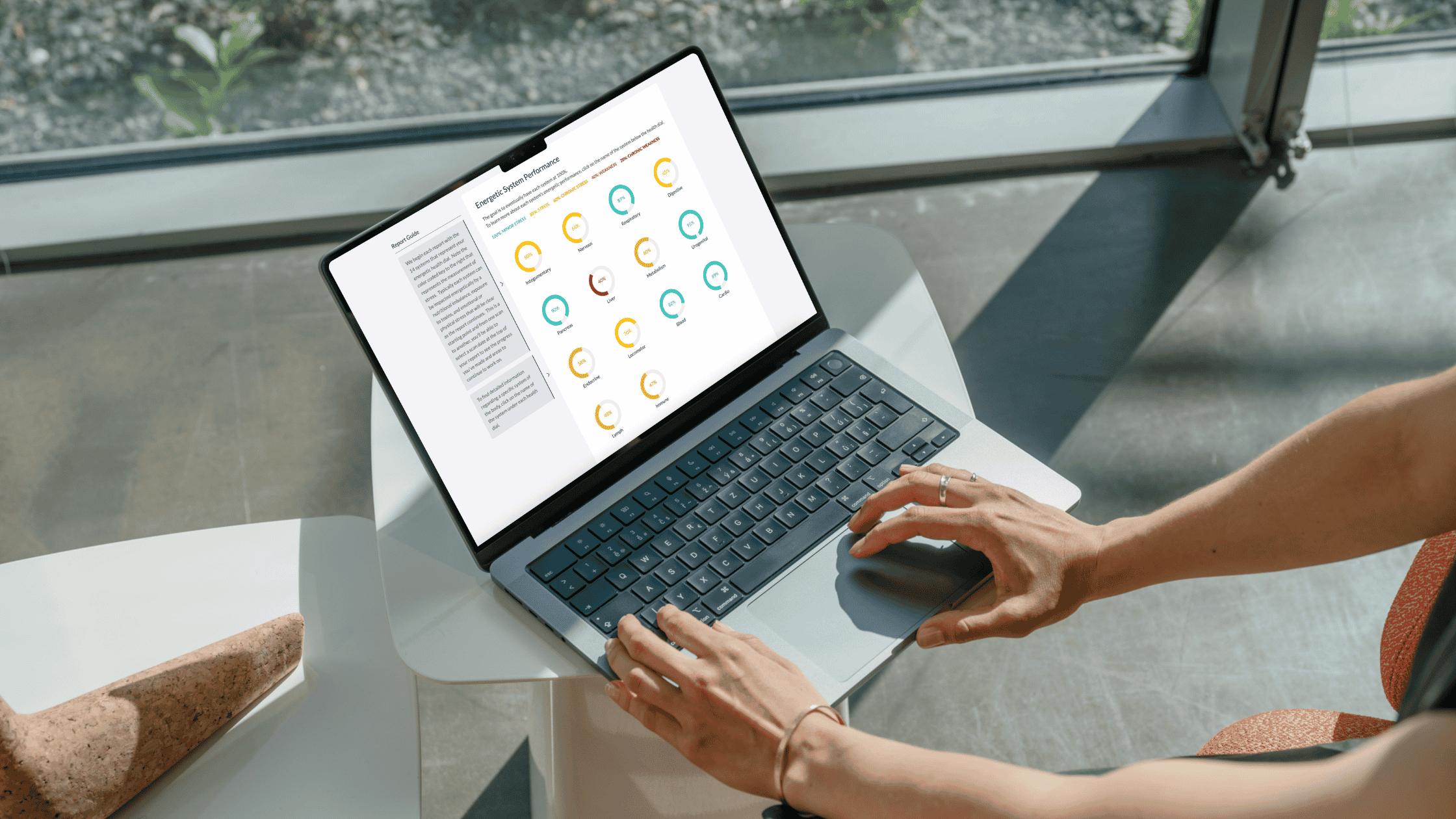
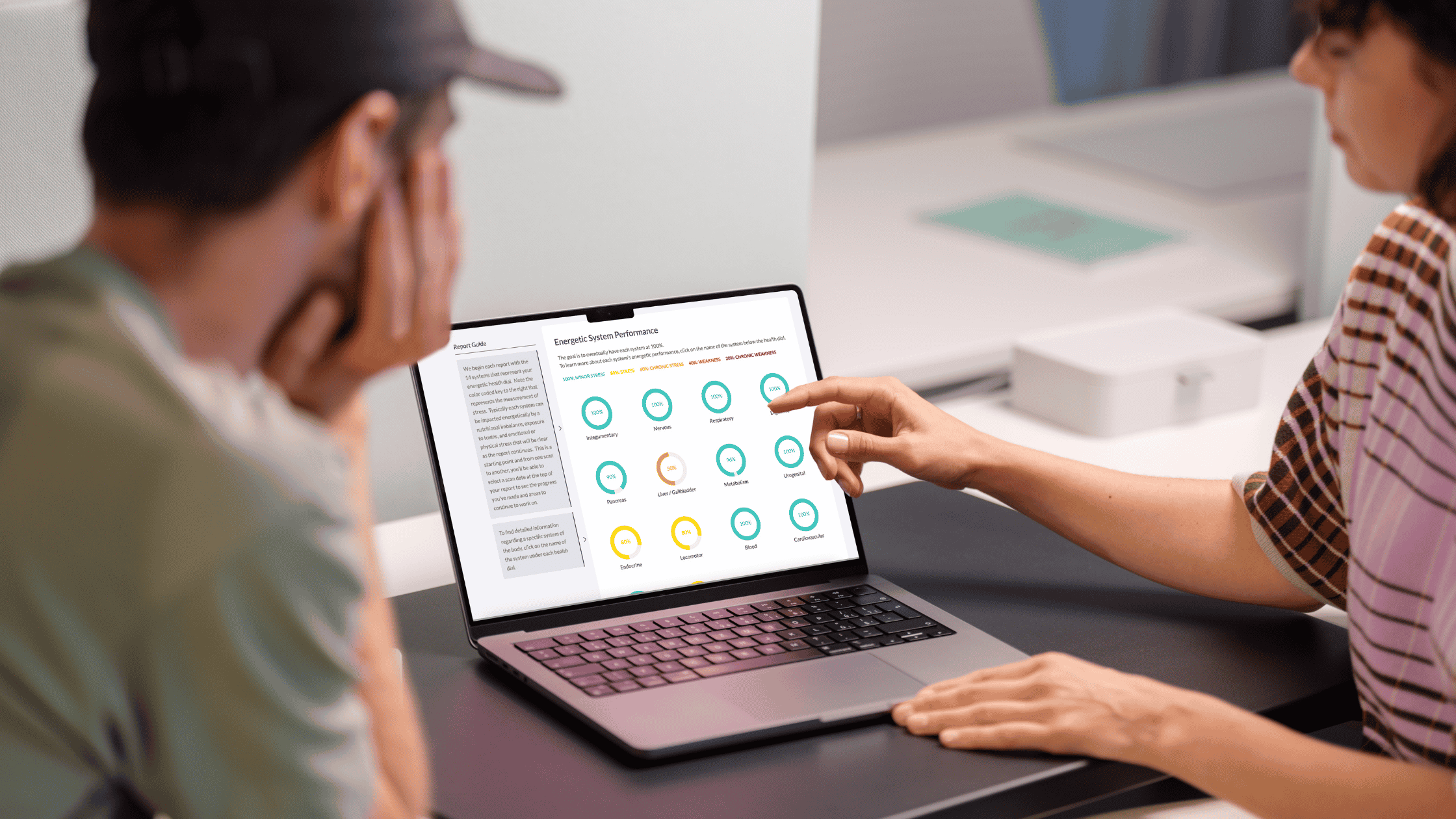
Start with the system overview: The 14 body systems section gives the broadest picture first. Walk through which systems are showing the most stress before zooming in on specific items that could be contributing to that stress. This gives the client a landscape before moving into the details.
Address emotionally charged categories carefully: Toxins and pathogens, including bacteria, viruses, parasites, mold and heavy metals, can carry the most emotional weight. Walk through these findings with immediate context every time: “This means your body’s energetic pattern is aligning with the signature of this item. That’s useful information. It is not telling us that you have an infection. It is telling us that this may be worth paying attention to.”
Connect findings to what the client already knows: Ask whether any findings feel familiar, such as foods they have suspected, symptoms they have described, or things that have appeared in other testing. When a bioenergetic finding connects to something the client already knows, it can help the results feel more relevant and understandable.
End with direction, not a list of problems: A well-facilitated report review should leave the client feeling clearer and more empowered, rather than overwhelmed. Summarize the two or three most significant patterns, explain the balancing remedies in plain language, and set a timeline for follow-up.
❓ Frequently Asked Questions
How does bioenergetic testing work? Every cell in the body is made of atoms that produce measurable energetic vibrations. Bioenergetic testing reads those vibrations and compares them against a library of known frequency signatures for nutrients, hormones, toxins, pathogens, foods, and environmental factors. When the body’s energetic pattern closely matches a reference signature, that item is flagged as resonating.
Is bioenergetics testing real? Bioenergetic testing is grounded in biofield physiology, the study of the electromagnetic fields that living systems generate and respond to. Research published in peer-reviewed journals, including Global Advances in Health and Medicine, has concluded that there is sufficient evidence to consider biofield physiology a viable scientific discipline.² The specific application of bioresonance technology to hair and saliva analysis for wellness assessment is less formally studied, which responsible practitioners acknowledge clearly. With over 50,000 CBH Energetics scans, it consistently shows a meaningful correlation between bioenergetic findings and what clients subsequently confirm through conventional testing.
How does a CBH bioenergetics scan differ from conventional allergy testing? A conventional allergy test looks for IgE antibodies in the blood, confirming that a specific immune response has occurred. A bioenergetics scan examines how the body’s energetic field responds to the frequency signatures of specific foods and environmental factors, a fundamentally different kind of information. The bioenergetics scan also reads the whole-body context that influences sensitivity patterns, including toxin load, microbial resonance, and system stress, rather than testing individual items in isolation.
How is bioenergetic testing different from blood work? Blood work measures the levels of biochemical markers in a sample at a specific point in time. Bioenergetic testing measures energetic pattern alignment across multiple body systems simultaneously — not what is physically present, but how the body’s energetic field is currently responding. For hormones specifically, blood work measures how much is present; bioenergetic testing reflects how well it is being utilized energetically. Both are valuable and complementary rather than competitive.
How does bioenergetics fit into a functional medicine practice? Many integrative and functional medicine practitioners use bioenergetic scanning as a whole-body first-pass assessment that helps prioritize whether other functional lab tests are worth ordering. The two approaches are complementary: functional medicine testing confirms biochemical dysfunction that has already developed; bioenergetic testing can surface energetic imbalances before they cross into detectable physical markers. Using them together often produces a more complete clinical picture than either alone’
Ready to Add CBH Energetics to Your Practice?
CBH Energetics has partnered with more than 1,000 practitioners worldwide — chiropractors, naturopaths, health coaches, nutritionists, acupuncturists, and functional medicine practitioners — who use bioenergetic scanning as a foundational tool in their client wellness assessments.
Our affiliate and private label programs are built for practitioners who want to offer clients a whole-body energetic picture that nothing else provides without in-office equipment, lab contracts, or scheduling friction. Every CBH scan is completed in your office or at home by the client, with results delivered digitally alongside personalized natural regimens matched specifically to their findings.
If you are ready to have better conversations with your clients about their whole-body health and to offer them a tool that looks where everything else hasn’t, we would love to talk.
About the Author
Founder, CBH Energetics
Samantha has over 14 years of experience and more than 50,000 bioenergetic scans analyzed worldwide. Her work focuses on identifying patterns of imbalance across systems and helping clients and practitioners understand the deeper connections driving their health challenges. She sits on the board of the American Intervention Institute.
Areas of expertise: Bioenergetic testing · Hormone balancing · Detoxification · Nervous system regulation · Metabolic health · Lyme disease
Research Links:
- Cifra M, Fields JZ, Farhadi A. Electromagnetic cellular interactions. Prog Biophys Mol Biol. 2011;105(3):223–246. https://pubmed.ncbi.nlm.nih.gov/20674588/
- Rubik B, Muehsam D, Hammerschlag R, Jain S. Biofield science and healing: History, terminology, and concepts. Glob Adv Health Med. 2015;4(Suppl):8–14. https://doi.org/10.7453/gahmj.2015.038.suppl
DISCLAIMER: Balanced Health, LLC/CBH Energetics and any parent, subsidiary, affiliated, or related entities and companies do not provide medical advice or services. This post and the bioenergetic products and services offered by Balanced Health, LLC/CBH Energetics including, but not limited to, bioenergetic tests, bioenergetic scans, bioenergetic reports and related products and services (collectively the “Bioenergetic Products and Services”) are designed for educational and informational purposes only and are not intended to diagnose, treat, cure, or prevent any disease, condition, complaint, illness or medical condition and are not a substitute for professional services or medical advice. Testing is not used for the purpose of obtaining information for the diagnosis, prevention, or treatment of disease or, the assessment of a health condition or for identification purposes.
