
Why Athletic Performance Isn’t Only About Effort, Discipline, or Protein Shakes.
Athletic performance isn’t just shaped by how many hours you train; it’s shaped by what your body is juggling underneath it all.
Some seasons, your workouts feel steady and strong. Other times? Everything feels just a little off. We all know those stretches: heavier-feeling legs, slower recovery, or strength that shows up one day and quietly slips away the next.
Most people chalk it up to motivation or aging, but performance shifts are usually tied to what your internal systems are managing—not your dedication.
These shifts tend to show up during busy seasons of life, midlife transitions, perimenopause, periods of higher stress, or when you’re trying to balance training with real life. Even people who train consistently, eat well, and hydrate notice these changes. Your effort stays the same, yet your output feels different.
That’s because exercise performance, stamina, and workout recovery depend on multiple internal systems working smoothly, not just discipline or routine.
Below are ten areas that have a much bigger influence on how your workouts feel than most people ever realize. These are the same areas bioenergetic testing helps bring into focus, giving you a deeper look at the energetic stress patterns shaping your athletic output.

1. Energy Production and Mitochondrial Function
Your mitochondria help turn food and oxygen into the energy your muscles use during a workout. When they’re under stress from overreaching, poor sleep, high life load, or environmental factors, you may feel:
- inconsistent strength
- slower output
- heavy-feeling legs
- difficulty maintaining intensity
Cellular stress also plays a part here. When your cells are working harder to keep up — whether from training load, environmental factors, or overall life stress — your energy can feel less stable even when your habits stay the same.
2. Muscle Recovery and Inflammation Resolution
Workout recovery isn’t only about rest days — it’s about how efficiently your body clears byproducts, calms inflammation, and repairs tissues.
When these processes slow down, you might notice:
- soreness that lingers longer than usual
- joints that feel a little “sticky”
- slower day-to-day recovery
- fatigue that shows up quickly in a session

Studies have found that intense or unaccustomed exercise can temporarily increase muscle damage markers like creatine kinase (CK) and lactate dehydrogenase (LDH), which correlate with delayed onset muscle soreness and changes in workout recovery.
The Athletic Performance Test Add-On bioenergetically analyzes over 360 items, including delayed-onset muscle soreness (DOMS), and supports your recovery and repair with tips on increasing circulation and waste removal, as well as nutrition and rest.
3. Strength Signaling and Muscle Repair
Strength isn’t just about lifting — it’s about how well your body rebuilds afterward. When mTOR signaling, protein synthesis, or creatine kinase patterns are under stress, your training efforts may not match your results.
You may notice:
- stalled muscle growth
- plateaus in power
- harder time increasing weight
- inconsistent muscle activation
Other aspects of muscle repair included in the Athletic Performance Test:
- Muscle Microtrauma Patterns
- Fibrotic Tissue Patterns
- Scar Tissue Patterns
- Collagen Cross-Link Integrity
Many of these scanned points relate to the subtleties of the Locomotor System, which includes all the components that support and move the body.
4. Circulation, Oxygen Delivery, and VO₂ Efficiency
Oxygen delivery is one of the core determinants of athletic performance. When circulation or oxygen use shifts, even familiar workouts can feel more demanding.
You may notice:
- early fatigue
- breathlessness that feels “out of proportion”
- reduced endurance
- legs that feel like they “fill up” quickly
Your VO₂ efficiency — how well your body uses oxygen during effort — also influences endurance, stamina, and the sense of “breaking down” sooner than expected. Higher VO₂ max values are associated with better endurance and, in large population studies, lower risk of cardiovascular disease and all-cause mortality.
5. Gut Health and Energy Extraction
Your gut plays a direct role in exercise performance. If digestion, enzyme reserves, or the microbiome are stressed, your body may not extract or utilize nutrients as efficiently.
This can lead to:
- fluctuating energy
- bloating after workouts
- feeling “puffy” or inflamed
- increased fatigue during training
Research on endurance athletes has shown that changes in gut microbiota and short-chain fatty acid production during multi-day events are linked to exercise performance, suggesting the gut is more connected to athletic output than most people realize.
This is why we bioenergetically assess patterns such as:
- SIBO Signatures
- Lipopolysaccharide (LPS Endotoxin)
- Microbiome Energy Extraction Signature
- Short Chain Fatty Acid Production Profile
- Butyrate Producers vs. Consumers (energetic signature)
- Digestive Enzyme Reserve

6. Hydration, Electrolytes, and Thermoregulation
Hydration isn’t only about drinking water. It’s about how well your cells move water, minerals, and heat.
When this system is stressed, you might notice:
- heat intolerance
- more cramping
- quicker fatigue
- trouble cooling down
Cellular hydration is also key. Even with plenty of water intake, your cells may still struggle to balance fluids, which affects muscle contraction, exercise performance, and recovery.
7. Neuromuscular Coordination and Movement Patterns
How your muscles fire — and in what sequence — shapes strength, speed, and stability. The nervous system influences reaction time, balance, coordination, and the feeling of being “connected” to your movements.
Stress in this category may look like:
- inconsistent form
- slower reaction time
- difficulty activating certain muscles
- imbalances between the left and right sides
- feeling unsteady during familiar movements
8. Tendons, Fascia, Joints, and Structural Stress
Even small amounts of structural stress can shift how strong, stable, or powerful your body feels. These patterns show up often in people who train regularly, especially through midlife.
You may notice:
- recurring tightness
- stiffness that limits movement
- small “tweaks” that come and go
- tension in joints or tendons
- reduced mobility
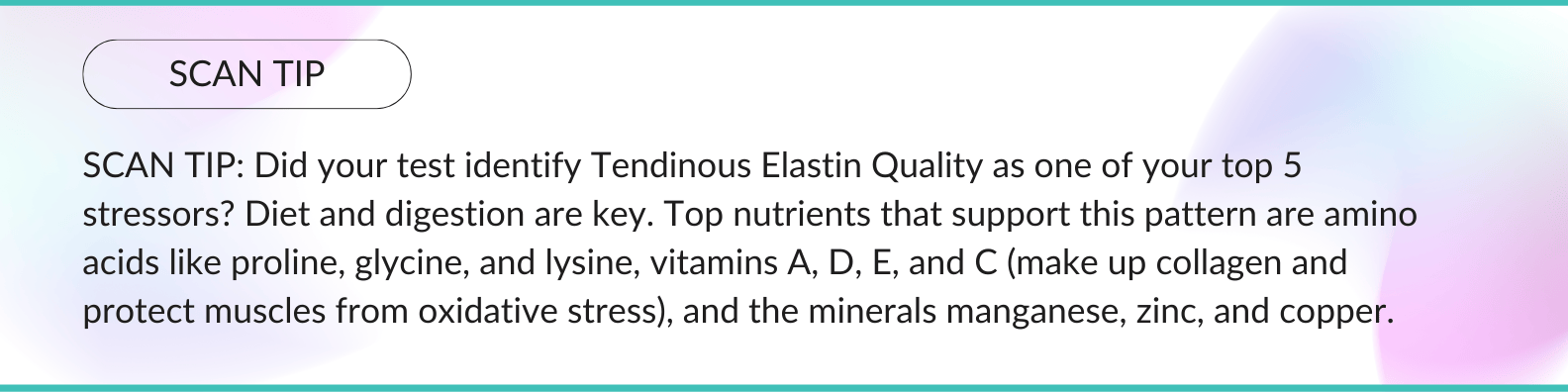
Other points of tendons, joints, fascia, and structural stress analyzed on testing are:
- Joint Capsule Hydration
- Cartilage Signatures
- Synovial Fluid Integrity
- Ligament Integrity Patterns
- Fascia Glide / Adhesion Patterns
9. Stress Load, Mental Fatigue, and Emotional Demand
Performance isn’t only physical. Your stress response, emotional bandwidth, sleep depth, and mental fatigue directly influence how your body trains and recovers.
Patterns here may show up as:
- feeling drained before a workout
- dips in motivation
- trouble pushing through sets you normally handle
- disrupted sleep
- elevated resting heart rate
Performance anxiety can also shift how steady your training feels. Even subtle stress patterns may affect focus, reaction time, and how easily you access strength during a session. Supporting yourself in training can include mindfulness and proper sleep hygiene.
10. Environmental Stressors That Influence Recovery
Your body works hard to process the world around you — including mold, microplastics, heavy metals, pesticides, chemicals, and water contaminants. These can create background stress that affects recovery and performance over time.
You may notice:
- more sluggish recovery
- shifts in stamina
- inflammation patterns that don’t make sense
- fatigue that’s hard to pinpoint
A clearer look at these internal factors is often what helps training feel more aligned and sustainable. Our Athletic Performance Test Add-On was created to give you insight into the stress patterns that shape strength, recovery, stamina, and workout output.
DISCLAIMER: Balanced Health, LLC/CBH Energetics and any parent, subsidiary, affiliated, or related entities and companies do not provide medical advice or services. This post and the bioenergetic products and services offered by Balanced Health, LLC/CBH Energetics including, but not limited to, bioenergetic tests, bioenergetic scans, bioenergetic reports and related products and services (collectively the “Bioenergetic Products and Services”) are designed for educational and informational purposes only and are not intended to diagnose, treat, cure, or prevent any disease, condition, complaint, illness or medical condition and are not a substitute for professional services or medical advice. Testing is not used for the purpose of obtaining information for the diagnosis, prevention, or treatment of disease or the assessment of a health condition or for identification purposes.
